
How to Diagnose Squeaking, Clicking, Grinding, and Rattling
A Pilates reformer does not have to be completely silent to be working properly.
Springs extend and recoil. Wheels travel along rails. Pulleys rotate. Ropes move under tension. Adjustable footbars, shoulder rests, spring hooks, and other mechanical connections can all produce some level of sound during normal operation.
What matters is what the sound is, when it occurs, where it comes from, and whether anything else changes at the same time.
A familiar light mechanical sound is very different from a new grinding noise accompanied by a rough carriage. Likewise, a brief click from an adjustable component may have a very different cause from a click that repeats every time a carriage wheel completes a rotation.
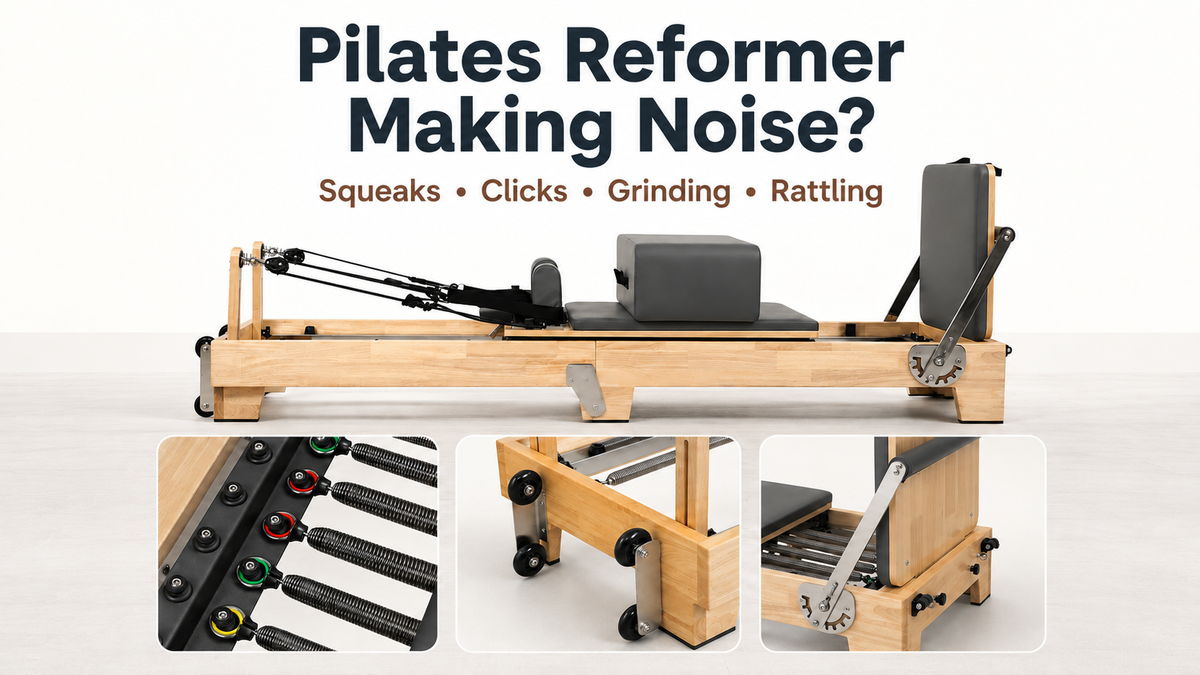
If your Pilates reformer has started squeaking, clicking, grinding, rattling, popping, scraping, or creaking, use the sound as a diagnostic clue rather than immediately assuming the entire machine has a problem.
This guide will help you narrow down the likely source before making adjustments or contacting support.
Important: This is a general Pilates reformer troubleshooting guide. Construction, wheel systems, bearings, spring assemblies, folding mechanisms, and lubrication requirements vary between models. Always follow the maintenance and service instructions for your specific reformer before removing parts, adjusting hardware, or applying lubricant.
First Question: Is the Reformer Noise New?
Before inspecting individual components, think about when the noise started.
Not every sound means something has worn out. Some reformers naturally produce more mechanical feedback than others because of differences in spring design, wheel materials, frame construction, bushings, carriage systems, or adjustment mechanisms.
A new or changing sound is generally more useful diagnostically than a sound the reformer has made consistently since it was assembled.
- Has the reformer always made this sound?
- Did the sound appear suddenly?
- Is it gradually becoming louder?
- Did it start after moving or reassembling the reformer?
- Did it begin after adjusting the footbar, ropes, pulleys, or springs?
- Does it occur with the carriage unloaded?
- Does it appear only when a person is on the carriage?
- Does the carriage still move smoothly?
- Has the spring resistance changed?
- Can you feel vibration, wobbling, or resistance when the noise occurs?
- Does the sound happen at exactly the same carriage position each time?
These details often tell you more than the volume of the noise itself. For example, a squeak that appears only while a spring stretches suggests a different inspection path from a squeak that occurs while the carriage rolls with little or no spring movement.
Quick Pilates Reformer Noise Diagnosis Chart
| Sound | When It Happens | Check First | Priority |
|---|---|---|---|
| Squeaking / squealing | Carriage moves | Rails, wheels, bearings | Medium |
| Squeaking | Spring stretches or recoils | Springs, hooks, attachment points | Medium |
| Clicking | Repeats during carriage travel | Wheels, bearings, hardware | Medium |
| Clicking | Only under body weight | Frame joints, fasteners, footbar | Medium |
| Grinding | Carriage moves | Wheels, bearings, rails, debris | High |
| Scraping | At one carriage position | Rail, wheel, carriage alignment, obstruction | Medium–High |
| Rattling | Direction changes or vibration occurs | Loose hardware, accessories, adjustment components | Medium |
| Popping / “boing” | Spring stretches or returns | Spring, hook, connector, alignment | Medium–High |
| Creaking | Getting on/off or loading the frame | Frame joints, feet, floor contact, fasteners | Medium |
This chart is only the first step. The next step is to identify exactly when the sound occurs.
If Your Pilates Reformer Is Squeaking
“Squeaking” is one of the most common descriptions users give to reformer noise, but it can originate from several completely different systems.
Do not assume that every squeak needs lubricant. Instead, determine whether the squeaking is associated with carriage travel, spring movement, rope movement, or frame loading.
Squeaking While the Carriage Moves
If the squeak occurs as the carriage glides forward and backward, inspect the carriage system first.
- carriage wheels or rollers
- wheel bearings
- carriage rails or tracks
- debris on the rail surface
- wheel-to-rail contact
- carriage alignment
- adjacent hardware contacting a moving component
First, resist the instinct to immediately add oil. Clean, dry rails are important for smooth carriage travel, and dust, hair, fibers, or small particles can change how a wheel interacts with the track.
With the reformer unoccupied, slowly move the carriage by hand and listen carefully.
Does the squeak happen continuously or only at one point?
A continuous squeak may indicate ongoing friction in a moving component. A sound that occurs at the same point of carriage travel may instead indicate a specific area of the rail, a wheel surface irregularity, a foreign object, contact between two components, or localized alignment issues.
Also pay attention to feel. A carriage that still feels smooth while making a light squeak presents a different troubleshooting situation from a carriage that feels rough, resistant, uneven, or unstable.
Squeaking When the Springs Stretch
If the carriage rolls quietly but the squeak appears when resistance is added, shift your attention toward the spring system.
- reformer springs
- spring hooks
- spring attachment points
- gearbar or spring bar connections
- spring alignment
- adjacent metal contact points
Look for visible abnormalities such as deformation, unusual gaps between coils, damaged hooks, loose connections, severe corrosion, or uneven spring positioning.
A reformer spring is a working mechanical component under repeated tension. Changes in its sound should therefore be considered together with changes in its shape, attachment, and resistance.
A spring that merely sounds different is not automatically unsafe, but a spring that sounds different and appears bent, damaged, loose, or significantly corroded should not simply be ignored.
Squeaking When You Get On or Off the Reformer
If the carriage is quiet when moved manually but you hear creaking or squeaking as body weight is applied, the source may not be the carriage at all.
- frame connections
- leg connections
- adjustable-height mechanisms
- footbar assembly
- rubber feet
- floor contact
- folding joints on foldable models
- structural fasteners
Also make sure the reformer is positioned on a stable, level surface. A slight movement between the reformer feet and flooring can sometimes sound as though it is coming from inside the frame.
If Your Pilates Reformer Is Clicking
A clicking noise can be especially useful because its frequency often helps identify the source. Instead of asking only, “Where is the click?” ask: When does each click occur?
Clicking Once Per Carriage Movement or Wheel Rotation
If clicking repeats in a regular rhythm as the carriage moves, inspect components that rotate with the carriage.
- carriage wheels
- rollers
- wheel bearings
- wheel surfaces
- nearby hardware
- debris attached to a wheel
- wheel-to-rail contact
Move the empty carriage slowly. If the clicking speeds up as the carriage moves faster and slows down as the carriage slows, the noise may be related to a rotating component.
Inspect each visible wheel or roller for unusual wear, flat spots, embedded debris, cracks, looseness, or side-to-side movement.
Clicking When the Carriage Changes Direction
If you hear a single click as the carriage reaches the end of its outward travel or begins returning, the problem may involve something that changes tension or position.
- springs
- spring hooks
- spring connectors
- carriage stopper
- rope tension
- pulley assembly
- adjustable hardware
- accessory connections
A component may be slightly shifting as force changes direction. A consistent light mechanical click without looseness or resistance is different from a new metallic impact accompanied by visible movement in a connection.
Clicking Only When Someone Is on the Reformer
If the machine moves quietly when empty but clicks under body weight, inspect load-bearing and adjustable components.
- frame fasteners
- footbar
- footbar support
- shoulder rests
- leg assemblies
- height-adjustment points
- folding pivots
- frame joints
- floor contact points
If any load-bearing component visibly shifts when the clicking occurs, stop exercising until the source has been identified.
If Your Pilates Reformer Is Grinding
Grinding requires more attention than a light squeak. A grinding or gritty sound during carriage movement can indicate abnormal contact in the rolling system.
- dust or debris on the rail
- damaged wheel surface
- worn roller
- bearing problems
- carriage misalignment
- an object trapped near the wheel
- abnormal contact between components
Start by inspecting the rails and visible wheel surfaces. Remove dust and debris using the cleaning method recommended for your model. Then, with the reformer unoccupied, move the carriage slowly by hand.
Pay attention to both sound and resistance.
Stop troubleshooting through repeated exercise if you notice:
- grinding combined with rough carriage travel
- sudden increase in resistance
- carriage wobbling
- visible wheel damage
- metal-on-metal contact
- abnormal lateral carriage movement
- a wheel that does not rotate normally
A Pilates reformer carriage should travel predictably. If grinding is accompanied by a change in how the carriage moves, identify the cause before continuing normal workouts.
If You Hear Scraping
Scraping often suggests that two surfaces are contacting each other when they should not.
Try to determine whether the scraping occurs throughout carriage travel, appears only near one end, happens at exactly the same position each time, occurs only under load, or began after the machine was moved or assembled.
Inspect for foreign objects near the rails, carriage-to-frame contact, wheel alignment, loose hardware, shifted components, accessories extending into the carriage path, and visible rub marks.
Fresh rub marks can be particularly useful diagnostic evidence. If you see scratches, polishing, metal dust, or wear marks that correspond with the sound, photograph them before adjusting anything. Those images can help customer support identify the problem more efficiently.
If Your Pilates Reformer Is Rattling
Rattling often comes from a component that is secure enough to remain attached but loose enough to vibrate during movement.
Before assuming an internal part has failed, inspect removable and adjustable components:
- shoulder rests
- footbar
- footbar pins or adjustment hardware
- pulley bar knobs
- rope hardware
- sitting box or accessories
- jumpboard attachment
- carriage stopper
- frame fasteners
- adjustable legs
- folding locks or related hardware
Remove any accessory that is not required for the test and move the empty carriage again. If the rattling disappears, reinstall accessories one at a time until the sound returns.
This simple elimination process can prevent unnecessary disassembly.
If You Hear a Pop, Snap, or “Boing” from the Spring Area
Spring systems naturally create mechanical sound as resistance changes, so the existence of a spring sound alone is not enough to diagnose a fault.
The important question is whether the sound is new, unusually loud, isolated to one spring, accompanied by altered resistance, or associated with visible spring or hook movement.
Inspect the spring body, spring hooks, attachment points, spring bar or gearbar, retaining components, and alignment of each spring.
If your owner's manual allows spring isolation for maintenance, use only the procedure specified for your model. Do not perform an exercise with springs detached simply as a troubleshooting test.
If one spring repeatedly produces a different sound from the others and also shows deformation, damaged hooks, abnormal resistance, or another visible defect, stop using that spring and contact the manufacturer or service provider.
What About Pulley and Rope Noise?
Not every reformer noise comes from the carriage or springs. The rope and pulley system may also generate squeaking, clicking, rubbing, or uneven rope movement.
Inspect rope condition, rope alignment, pulley rotation, pulley mounting hardware, straps, rope guides, and rope length adjustment.
Look for fraying, flattening, damaged stitching, misalignment, or a rope rubbing against a surface it normally clears.
Move the rope slowly through its normal path while the reformer is unoccupied. The pulley should rotate consistently and the rope should track correctly.
If the pulley sticks, binds, moves unevenly, or produces a new grinding sound, avoid repeatedly loading the system until it has been inspected.
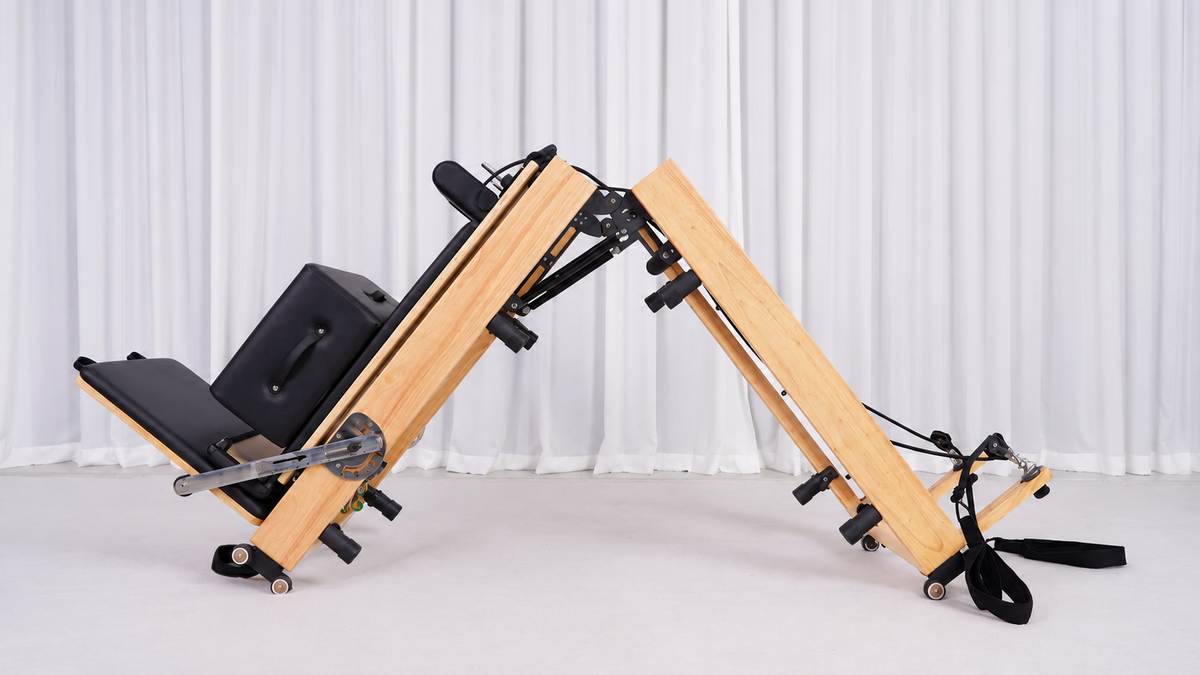
What About Noise from a Foldable Pilates Reformer?
Foldable Pilates reformers introduce additional moving connections that fixed-frame reformers may not have.
- folding pivots
- hinge points
- locking mechanisms
- adjustable legs
- linkages
- gas-spring-assisted mechanisms
- frame-to-frame connections
If the noise appears only while folding or unfolding rather than during Pilates exercise, treat it as a folding-system issue first rather than a carriage problem.
Identify whether the sound comes from a pivot point, frame contact, a locking component, an adjustable connection, or another part moving as the reformer changes position.
Do not place fingers near hinges, pivot points, folding joints, or other pinch areas while trying to locate the sound.
For more detail on this type of folding system, read how a gas spring with hydraulic damping supports controlled folding.
A 5-Minute Pilates Reformer Noise Isolation Check
Step 1: Stop the Workout and Inspect Visually
Check the main areas you can see without disassembly: rails, wheels, springs, ropes, footbar, shoulder rests, fasteners, accessories, and frame connections.
Look for obvious looseness, debris, deformation, fraying, damage, or anything out of position.
Step 2: Remove Loose Accessories
If safe and appropriate for the model, remove accessories that are not necessary for the test, such as a sitting box, jumpboard, removable handles, or other detachable accessories. Then check whether the rattle or vibration remains.
Step 3: Move the Empty Carriage Slowly
With nobody on the equipment, slowly move the carriage through its available range according to the manufacturer's instructions.
Listen for continuous noise, periodic clicking, noise at one position, and noise when direction changes. Also feel whether carriage resistance remains consistent.
Step 4: Compare Loaded and Unloaded Behavior Carefully
If the reformer is visually safe and no stop-use warning signs are present, compare the normal operating sound with what you heard during exercise.
Do not deliberately continue exercising on equipment that is grinding, wobbling, visibly loose, or moving abnormally merely to reproduce the noise. The purpose is diagnosis—not stress testing.
Step 5: Identify Which System Changes When the Noise Appears
Does the noise correspond with carriage movement? Check the rolling system.
Does it correspond with spring stretch? Check springs and attachment points.
Does it correspond with rope movement? Check pulleys, ropes, and guides.
Does it happen only under load? Check structural and adjustable connections.
Does it occur only while folding? Check the folding system.
Step 6: Record a Short Video
If you cannot confidently identify the source, record the problem before making major changes.
- Show the whole reformer.
- Show the area where the sound seems loudest.
- Show the carriage moving slowly.
- Show whether springs are engaged.
- Capture the exact point at which the noise occurs.
A 15- to 30-second video can often communicate more than several paragraphs describing a “strange noise.”
What NOT to Do When Your Reformer Starts Making Noise
Do Not Lubricate Every Squeak Automatically
Different Pilates reformers use different wheel materials, bearings, rails, bushings, spring connections, and pulley systems. Lubrication instructions therefore vary by manufacturer and component.
Use only the lubricant—and only the location—specified for your reformer model.
Do not assume household oil, industrial grease, penetrating oil, or another general-purpose product is suitable.
Do Not Keep Exercising to See Whether Grinding Goes Away
A minor sound and a mechanical change are not the same thing.
If the reformer is simultaneously harder to move, wobbling, scraping, binding, shifting sideways, or showing visible damage, stop and inspect it.
Do Not Make Several Adjustments at Once
If you tighten several bolts, clean the rails, change the spring setup, adjust the ropes, and lubricate a component all at once, you may never know what caused the noise.
Change one variable at a time whenever possible. This makes troubleshooting more reliable.
Do Not Disassemble Safety-Critical Parts Without Instructions
Spring systems, folding mechanisms, carriage assemblies, footbars, pulleys, and structural connections may be under load or may require a specific assembly procedure.
Use the model's manual or visit the Gymfrog Reformer installation guides and product manuals.
If a repair requires internal disassembly or you are uncertain about the correct configuration, contact support.
When Should You Stop Using a Noisy Pilates Reformer?
Not every squeak requires you to stop training, but some combinations of noise and mechanical symptoms should be treated more seriously.
Stop using the reformer and inspect it further if you notice:
- grinding combined with rough carriage movement
- sudden or significant increase in carriage resistance
- carriage wobbling or lateral movement
- visible wheel or roller damage
- a wheel that does not rotate correctly
- severe scraping or metal-to-metal contact
- a deformed spring
- damaged spring hooks or attachment points
- a loose spring connector
- a frayed or damaged rope
- unstable footbar movement
- structural fasteners that will not remain secure
- abnormal frame movement
- damaged folding or locking components
- a sudden metallic impact sound
- noise combined with a noticeable change in resistance
When in doubt, continuing to exercise is not a diagnostic method. Identify the source first.
What Information Should You Send Customer Support?
If basic inspection does not identify the cause, providing the right information can significantly shorten the troubleshooting process.
| Information | What to Provide |
|---|---|
| Reformer model | Exact model name if available |
| Type of sound | Squeak, click, grind, rattle, scrape, pop, creak |
| Approximate location | Front, rear, carriage, rail, spring area, pulley, frame |
| When it happens | Carriage moves, springs stretch, body weight is applied, folding |
| Loaded or unloaded | Whether it occurs with nobody on the carriage |
| Spring configuration | Which springs are attached during normal use |
| Carriage direction | Outward, return, both directions |
| When it started | Suddenly, gradually, after assembly, after moving |
| Recent changes | New spring, rope adjustment, relocation, accessory installation |
| Visible issue | Wear, debris, deformation, loose hardware, rub marks |
| Video | 15–30 seconds showing sound and movement |
For Gymfrog equipment, contact Gymfrog support with these details for model-specific assistance.
How Regular Maintenance Helps Prevent Reformer Noise
Troubleshooting identifies a problem after you notice it. Maintenance has a different purpose: reducing the chance that avoidable problems develop in the first place.
Regular care should include model-appropriate inspection of carriage rails, wheels or rollers, springs, spring hooks, ropes and straps, pulley systems, footbar hardware, frame fasteners, folding mechanisms, and adjustment points.
For a structured preventive schedule, refer to the Gymfrog Pilates Reformer Maintenance & Care Guide rather than using this troubleshooting article as a replacement for regular maintenance.
That guide covers routine cleaning and inspection, while this article is designed to help you diagnose a sound that has already appeared.
Frequently Asked Questions About Pilates Reformer Noise
Should a Pilates reformer be completely silent?
No. A Pilates reformer is a mechanical exercise machine with moving wheels or rollers, springs, ropes, pulleys, and adjustable components. Some operational sound can be normal, and different reformer designs have different sound characteristics. More important than absolute silence is whether the sound is new, changing, unusually loud, or accompanied by abnormal movement, resistance, looseness, or visible damage.
Why does my Pilates reformer squeak when the carriage moves?
If the squeak follows carriage movement, first inspect the carriage rails, wheels or rollers, bearings, and visible contact points. Dust or debris may affect wheel-to-rail contact, but wheel wear, bearing issues, alignment, or other mechanical contact can also produce noise. Clean and inspect before automatically applying lubricant.
Why does my reformer click only when I put weight on it?
A click that appears under load but not while the empty carriage moves may come from a structural or adjustable connection rather than the wheel system. Inspect areas such as frame fasteners, footbar connections, shoulder rests, adjustable legs, folding joints, and floor contact points. If you can see a component shifting when the click occurs, stop using the reformer until the connection has been checked.
Why is my Pilates reformer spring squeaking?
Spring-related sound can originate from the spring itself, its hooks, attachment points, or neighboring metal contact surfaces. Check whether the sound is isolated to one spring and inspect for deformation, damaged hooks, looseness, unusual corrosion, or a change in spring resistance. Do not assume that every spring squeak requires lubrication.
Can I use WD-40 or oil to stop my reformer from squeaking?
Do not apply a general-purpose lubricant unless the manufacturer specifically recommends it for that component and model. Pilates reformers use different wheel, bearing, rail, pulley, bushing, and spring systems, so there is no universal lubricant that should automatically be applied to every squeak.
Why does my reformer make a grinding sound?
Grinding during carriage movement may be associated with debris, damaged wheel surfaces, bearings, alignment, or abnormal contact. If grinding is accompanied by rough movement, increased resistance, wobbling, or visible damage, stop using the reformer until the source has been identified.
Why does my Pilates reformer rattle?
Rattling frequently comes from removable or adjustable components such as the footbar, shoulder rests, pulley hardware, accessories, adjustment knobs, frame fasteners, or folding hardware. Remove nonessential accessories when safe to do so and test systematically before disassembling structural parts.
Is it safe to keep using a reformer that makes noise?
It depends on the type of noise and whether other symptoms are present. A familiar, consistent operational sound may not indicate a problem. A new noise accompanied by grinding, rough carriage movement, visible damage, looseness, unstable components, changed resistance, or structural movement should be investigated before continuing exercise.
Final Takeaway
When a Pilates reformer starts making noise, the sound itself is only part of the diagnosis.
The most useful questions are:
- What does it sound like?
- When does it happen?
- Which component is moving at that moment?
- Does the carriage still feel smooth?
- Does the noise occur only under load?
- Is anything loose, worn, damaged, or misaligned?
A squeak, click, rattle, grinding sound, pop, or creak can each point you toward a different area of the equipment.
Identify the sound → identify when it occurs → isolate the moving system → inspect visible components → decide whether normal use should continue.
Keeping your carriage rails, wheels, springs, ropes, pulleys, fasteners, and adjustment points properly inspected can help maintain smooth and predictable reformer performance over time.
If you own a Gymfrog reformer and cannot identify the source of an unusual sound, record a short video and contact Gymfrog support with your model name, sound location, spring configuration, and the conditions under which the noise occurs.
To explore Gymfrog equipment, visit the Gymfrog Pilates Reformers collection.

Leave a comment
This site is protected by hCaptcha and the hCaptcha Privacy Policy and Terms of Service apply.